
- Home
- Arts & Culture
- Polygon Pictures' Shuzo Shiota on four decades of animation at SACC 2026
Polygon Pictures' Shuzo Shiota on four decades of animation at SACC 2026
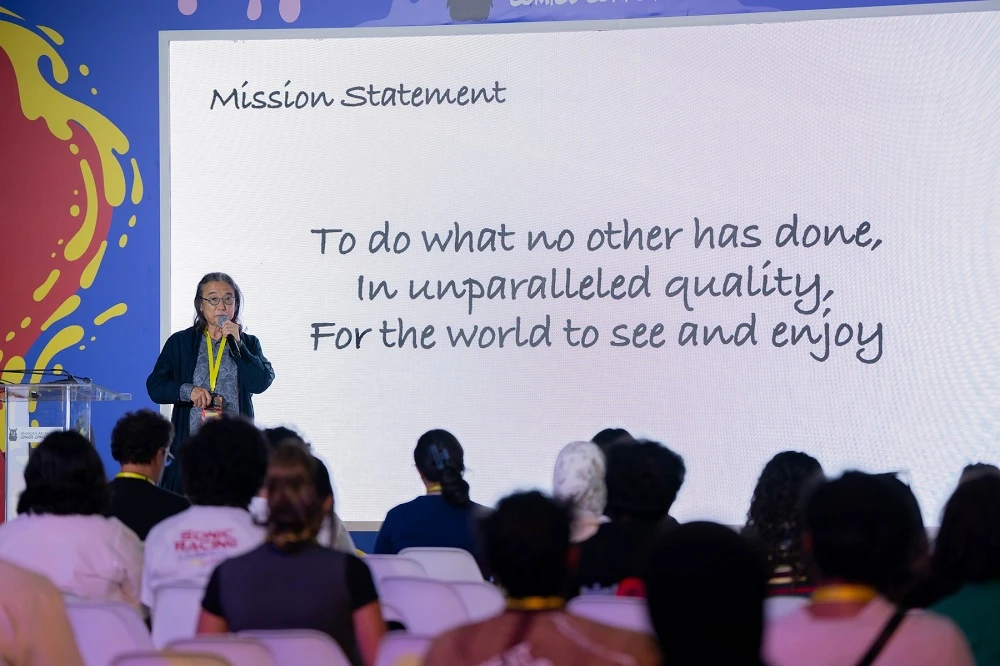


At the Sharjah Animation and Comics Conference (SACC) 2026, the CEO of Japan’s Polygon Pictures traced the studio’s journey from writing its own 3D software in the 1980s to global productions, interactive cinema and a workforce of 450 artists across three countries.
Along the way came a penguin character that generated millions in merchandise, a feature film that consumed $30 million and produced just three finished minutes, and a factory-management philosophy that helped rescue the company from another financial squeeze.
During the session 40+ Years of Polygon Pictures, Shiota showed how technological experimentation, ownership of intellectual property and hard-earned production discipline shaped a studio that would eventually work on Godzilla, Pokémon, Spider-Man and Star Wars.
Forty years in animation taught Shuzo Shiota that some of the industry’s biggest breakthroughs can begin with failure.
“A film the audience directs”, Polygon’s continued experimentation with audience participation is reflected in Hypnosis Mic, an interactive feature in which viewers vote during screenings to determine what happens next. The film has 48 possible storylines and seven endings, with some fans returning dozens of times and a few watching it 100 or 200 times.
“From CGI pioneer to IP owner”, Shiota recalled a period when 3D tools were so limited that Polygon wrote its own software. Japan was among the leaders in computer graphics until Hollywood’s resources surged, with Jurassic Park in 1993 making the studio’s own computer-animated dinosaur suddenly look modest.
“We said, man, that’s really good,” he recalled.
A more important breakthrough came in 1995, when Polygon created the Rockhopper penguins for a Shiseido commercial and retained the character rights. Merchandise generated about $150 million over three years, with Polygon earning royalties of 3 to 5%.
“For the first time in Polygon’s history, we were making money from royalties, not just production,” Shiota said.
“$30 million for three minutes”, That same year, Toy Story arrived and “everybody wanted to be the next Pixar”, Shiota said.
Polygon joined Namco and Sony Computer Entertainment on a feature film budgeted at $80 million, but after two and a half years and $30 million spent, only three minutes of finished footage had been produced.
“We hired a lot of people and bought very expensive workstations, but we didn’t realise you can’t make a film without a script,” he said.
“The kaizen turnaround”, Polygon then regrouped around television production. When exchange-rate pressures later threatened profitability on My Friends Tigger & Pooh, Shiota turned to kaizen, the continuous-improvement method he had first encountered at Nippon Steel.
Production efficiency rose by 28%, helping the studio go on to work on Transformers: Prime, Tron: Uprising and Star Wars: The Clone Wars.
“Whatever issue there is, there is a precedent. Find it,” he said.
“450 artists, 20 projects”, Polygon later developed a distinctive style blending CGI with an illustrative look rather than photorealism, leading to Knights of Sidonia, the first original Japanese anime licensed by Netflix.
Today, the studio employs about 450 artists across Japan, Malaysia and India and works on around 20 projects at a time. Shiota said Polygon’s mission has remained unchanged: “To do what no others have done, at unparalleled quality, for the world to see and enjoy.”
He closed by noting that the word “animation” comes from the Latin root associated with giving life or soul. Four decades after Polygon began experimenting with computer graphics, the tools, business models and ways audiences engage with animation may have transformed, but for Shiota, the essential task remains the same: giving life to ideas that people want to watch, remember and return to.